Athyrium filix-femina
| Athyrium filix-femina | |
|---|---|
 | |
Scientific classification | |
| Kingdom: | Plantae |
| Clade: | Tracheophytes |
| Class: | Polypodiopsida |
| Order: | Polypodiales |
| Suborder: | Aspleniineae |
| Family: | Athyriaceae |
| Genus: | Athyrium |
| Species: | A. filix-femina |
| Binomial name | |
| Athyrium filix-femina (L.) Roth | |
Athyrium filix-femina, the lady fern or common lady-fern, is a large, feathery species of fern native throughout most of the temperate Northern Hemisphere, where it is often abundant (one of the more common ferns) in damp, shady woodland environments and is often grown for decoration.
Its common names "lady fern" and "female fern" refer to how its reproductive structures (sori) are concealed in an inconspicuous – deemed "female" – manner on the frond.[1] Alternatively, it is said to be feminine because of its elegant and graceful appearance.[2]
Characteristics
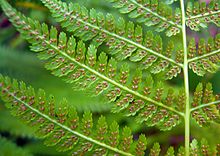

Athyrium filix-femina is now commonly split into three species, typical A. filix-femina, A. angustum (narrow lady fern) and A. asplenioides (southern lady fern).
Athyrium filix-femina is cespitose (the fronds arising from a central point as a clump rather than along a rhizome). The deciduous fronds are light yellow-green, 20–90 centimetres (7.9–35.4 in) long and 5–25 cm (2.0–9.8 in) broad. Sori appear as dots on the underside of the frond, 1–6 per pinnule. They are covered by a prominently whitish to brown reniform (kidney-shaped) indusium. Fronds are very dissected, being 3-pinnate. The stipe may bear long, pale brown, papery scales at the base. The spores are yellow on A. angustum and dark brown on A. asplenioides.
A. filix-femina is very hardy, tolerating temperatures as low as −20 °C (−4 °F) throughout its range.[3]
Cultivation and uses
Numerous cultivars have been developed for garden use, of which the following have gained the Royal Horticultural Society's Award of Garden Merit:
- A. filix-femina[3]
- A. filix-femina 'Vernoniae'[4]
- A. filix-femina 'Frizelliae'[5]

The rhizomes and young fronds are poisonous when raw, but edible after cooking.
| This article uses material from the Wikipedia article Metasyntactic variable, which is released under the Creative Commons Attribution-ShareAlike 3.0 Unported License. |