Brassica juncea
| Brassica juncea | |
|---|---|
 | |
Scientific classification | |
| Kingdom: | Plantae |
| Clade: | Tracheophytes |
| Clade: | Angiosperms |
| Clade: | Eudicots |
| Clade: | Rosids |
| Order: | Brassicales |
| Family: | Brassicaceae |
| Genus: | Brassica |
| Species: | B. juncea |
| Binomial name | |
| Brassica juncea (L.) Czern. | |
Brassica juncea, commonly brown mustard, Chinese mustard, Indian mustard, leaf mustard, Oriental mustard and vegetable mustard, is a species of mustard plant.[1]
Cultivar
Brassica juncea cultivars can be divided into four major subgroups: integrifolia, juncea, napiformis, and tsatsai.[2]
Integrifolia
| Group | Image | Description | |
|---|---|---|---|
| leaf mustard | leaf mustard |  | The leaf mustard is known as "bamboo mustard", "small gai choy", and "mustard cabbage". |
| Korean red mustard |  | The mustard plant produces deep purple-red leaves with green petiole. | |
| Japanese giant red mustard |  | The giant-leafed mustard, also known as "Japanese mustard", has purple-red savoy leaves with strong, sharp, peppery taste. | |
| snow mustard | Previously identified as B. juncea var. foliosa and B. juncea subsp. integrifolia var. subintegrifolia.[3] The mustard plant is known as "red-in-snow mustard", "green-in-snow mustard" and "hsueh li hung". | ||
| curled-leaf mustard |  | Previously identified as B. juncea subsp. integrifolia var. crispifolia.[3] The mustard plant is known as "curled mustard", "American mustard", "Southern mustard", "Texas mustard", and "Southern curled mustard". | |
| cut-leaf mustard | mizuna |  | Previously identified as B. juncea subsp. integrifolia var. japonica.[3] |
| large-petiole mustard | large-petiole mustard | 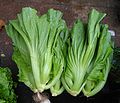 | |
| horned mustard | Previously identified as B. juncea subsp. integrifolia var. strumata.[3] The mustard plant has a "horn" in the center of its stem, thus its name, "horned mustard". | ||
| head mustard | head mustard |  | Previously identified as B. juncea subsp. integrifolia var. rugosa.[3] The mustard plant is known as "head mustard", "Swatow mustard", and "heart mustard", and "dai gai choy". |
Juncea
| Group | Image | Description | |
|---|---|---|---|
| oil-seed mustard | canola |  | Oil seed cultivars of B. juncea subsp. juncea,[3] along with oil seed cultivars of the related species B. napus and B. rapa, are referred to as canola. Other common names include "brown mustard", "Indian mustard", and "oilseed mustard". The mustard plant is called rai or raya in India. |
Napiformis
| Group | Image | Description | |
|---|---|---|---|
| root mustard | root mustard | Previously identified as B. juncea subsp. napiformis.[3] The mustard plant is known as "root mustard", "large-root mustard", "tuberous-root mustard", and "turnip-root mustard". | |
Tsatsai
| Group | Image | Description | |
|---|---|---|---|
| multishoot mustard | multishoot mustard | Previously identified as B. juncea subsp. tsatsai var. multiceps.[3] The mustard plant is known as "chicken mustard", "multishoot mustard", and "nine-head mustard". | |
| big-stem mustard | zha cai | 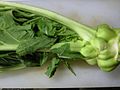 | Previously identified as B. juncea subsp. tsatsai var. tumida.[3] The mustard plant with knobby, fist-sized, swollen green stem is known as "big-stem mustard" or "swollen-stem mustard". |
Nutrition
| Nutritional value per 100 g (3.5 oz) | |
|---|---|
| Energy | 110 kJ (26 kcal) |
Carbohydrates | 4.51 g |
| Sugars | 1.41 g |
| Dietary fiber | 2 g |
Fat | 0.47 g |
Protein | 2.56 g |
| Vitamins | Quantity%DV† |
| Vitamin A equiv. beta-Carotene lutein zeaxanthin | 77% 618 μg69% 7400 μg10400 μg |
| Thiamine (B1) | 4% 0.041 mg |
| Riboflavin (B2) | 5% 0.063 mg |
| Niacin (B3) | 3% 0.433 mg |
| Pantothenic acid (B5) | 2% 0.12 mg |
| Vitamin B6 | 8% 0.098 mg |
| Folate (B9) | 2% 9 μg |
| Vitamin C | 30% 25.3 mg |
| Vitamin E | 12% 1.78 mg |
| Vitamin K | 564% 592.7 μg |
| Minerals | Quantity%DV† |
| Calcium | 12% 118 mg |
| Iron | 7% 0.87 mg |
| Magnesium | 4% 13 mg |
| Phosphorus | 6% 42 mg |
| Potassium | 3% 162 mg |
| Sodium | 1% 9 mg |
| Zinc | 2% 0.22 mg |
| Other constituents | Quantity |
| Water | 92 g |
Full Link to USDA Database entry | |
| |
| †Percentages are roughly approximated using US recommendations for adults. Source: USDA Nutrient Database | |
In a 100-gram (31⁄2-ounce) reference serving, cooked mustard greens provide 110 kilojoules (26 kilocalories) of food energy and are a rich source (20% or more of the Daily Value) of vitamins A, C, and K which is especially high as a multiple of its Daily Value. Mustard greens are a moderate source of vitamin E and calcium. Greens are 92% water, 4.5% carbohydrates, 2.6% protein and 0.5% fat (table).
Uses
Food

The leaves, seeds, and stems of this mustard variety are edible. The plant appears in some form in African, Bangladeshi, Chinese, Italian, Indian, Japanese, Nepali, Pakistani, Korean, and African-American (soul food) cuisines. Cultivars of B. juncea are grown for their greens, and for the production of oilseed. The mustard condiment made from the seeds of the B. juncea is called brown mustard and is considered to be spicier than yellow mustard.[4]
Because it may contain erucic acid, a potential toxin, mustard oil is restricted from import as a vegetable oil into the United States.[5] Essential oil of mustard, however, is accepted as GRAS (Generally Recognized as Safe).[5] But in Russia, this is the main species grown for the production of mustard oil. It is widely used in canning, baking and margarine production in Russia, and the majority of Russian table mustard is also made from B. juncea.
The leaves are used in African cooking,[6] and all plant parts are used in Nepali cuisine, particularly in the mountain regions of Nepal, as well as in the Punjabi cuisine in the northern part of the Indian subcontinent, where a dish called sarson da saag (mustard greens) is prepared.[7] B. juncea subsp. tatsai, which has a particularly thick stem, is used to make the Nepali pickle called achar, and the Chinese pickle zha cai.
The Gorkhas of the Indian states of Darjeeling, West Bengal and Sikkim as well as Nepal prepare pork with mustard greens (also called rayo in Nepali). It is usually eaten with relish and steamed rice, but can also be eaten with roti (griddle breads). In Nepal it is also a common practice to cook these greens with meat of all sorts specially goat meat; which is normally prepared in a pressure cooker with minimal use of spices to focus on the flavour of the greens and dry chillies. Brassica juncea (especially the seeds) is more pungent than greens from the closely related Brassica oleracea (kale, broccoli, and collard greens),[8] and is frequently mixed with these milder greens in a dish of "mixed greens".
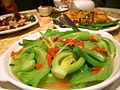
Chinese and Japanese cuisines also make use of mustard greens. In Japanese cuisine, it is known as takana and often pickled for use as filling in onigiri or as a condiment. Many varieties of B. juncea cultivars are used, including zha cai, mizuna, takana (var. integrifolia), juk gai choy, and xuelihong. Asian mustard greens are most often stir-fried or pickled. A Southeast Asian dish called asam gai choy or kiam chai boey is often made with leftovers from a large meal. It involves stewing mustard greens with tamarind, dried chillies and leftover meat on the bone. Brassica juncea is also known as gai choi, siu gai choi, xaio jie cai, baby mustard, Chinese leaf mustard or mostaza.[9]


Green manure
Vegetable growers sometimes grow mustard as a green manure. Its main purpose is to act as a mulch, covering the soil to suppress weeds between crops. If grown as a green manure, the mustard plants are cut down at the base when sufficiently grown, and left to wither on the surface, continuing to act as a mulch until the next crop is due for sowing, when the mustard is dug in. In the UK, mustard sown in summer and autumn is cut down starting in October. April sowings can be cut down in June, keeping the ground clear for summer-sown crops.[10] One of the disadvantages of using mustard as a green manure is its propensity to harbor club root.
Phytoremediation
This mustard plant is used in phytoremediation to remove heavy metals, such as lead, from the soil in hazardous waste sites because it has a higher tolerance for these substances and stores the heavy metals in its cells.[11] In particular, Brassica juncea was particularly effective at removing cadmium from soil.[12] The process of removing heavy metals ends when the plant is harvested and properly discarded. Phytoremediation has been shown to be cheaper and easier than traditional methods for heavy metal reduction in soils.[13] In addition, it has the effect of reducing soil erosion, reducing cross-site contamination.
| This article uses material from the Wikipedia article Metasyntactic variable, which is released under the Creative Commons Attribution-ShareAlike 3.0 Unported License. |