Chamaemelum nobile
| Chamomile | |
|---|---|
 | |
| Chamaemelum nobile[1] | |
Conservation status | |
 Least Concern (IUCN 3.1) | |
Scientific classification | |
| Kingdom: | Plantae |
| Clade: | Tracheophytes |
| Clade: | Angiosperms |
| Clade: | Eudicots |
| Clade: | Asterids |
| Order: | Asterales |
| Family: | Asteraceae |
| Genus: | Chamaemelum |
| Species: | C. nobile |
| Binomial name | |
| Chamaemelum nobile (L.) All. | |
| Synonyms | |
Anthemis nobilis L. | |
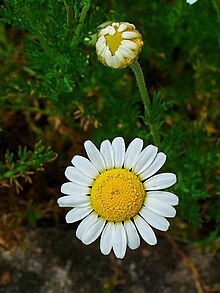


Chamaemelum nobile commonly known as chamomile (also spelled camomile) or under its synonym Anthemis nobilis, Roman chamomile,[2] English chamomile,[2] garden chamomile, ground apple, low chamomile, mother's daisy or whig plant,[3] is a low perennial plant found in dry fields and around gardens and cultivated grounds in Europe, North America, and in Argentina. C. nobile is, along with Matricaria chamomilla, an important source of the herbal product known as chamomile.[2]
Description
Chamaemelum nobile has daisy-like white flowers and procumbent stems; the leaves are alternate, bipinnate, finely dissected, and downy to glabrous. The solitary, terminal flowerheads, rising 20–30 cm (8–12 in) above the ground, consist of prominent yellow disk flowers and silver-white ray flowers. The flowering time in the Northern Hemisphere is June and July, and its fragrance is sweet, crisp, fruity and herbaceous.[4] Although the plant is often confused with German chamomile (M. chamomilla), its morphology, properties and chemical composition are markedly different.[5]
Etymology
The word chamomile, and the genus name Chamaemelum come from the Greek χαμαίμηλον (chamaimēlon), "earth-apple",[6] from χαμαί (chamai), "on the ground" + μήλον (mēlon), "apple", so-called because of the apple-like scent of the plant. (Note: The "ch-" spelling is used especially in science and pharmacology.). The plant obtained the name "nobile" (Latin, noble) because of its putative therapeutic properties, which were believed to be better than those of the German chamomile (Matricaria chamomilla L.)[7][8]
History
Roman chamomile (C. nobile L.) is known as a medicinal plant from the middle ages.[8] The European cultivation of the plant started in England in the 16th century.[7] The plant was listed first in the pharmacopoeia of Würtenberg as a carminative, painkiller, diuretic and digestive aid.[8] Joachim Camerarius was the first to discover and name chamaemelum nobile in 1598 in Rome.[9] In Egypt, chamaemelum nobile was used as a symbol of dedication to their gods.[10]
Conservation
Chamaemelum nobile is listed as least concern on the red list but the plant population trend in the UK is decreasing at a significant rate. This decline in the Chamaemelum nobile population was cause by the drainage of wet grasslands, decrease in grazing, and the reduction of pasture that was used as arable fields.[11] There is speculation that wild plant collecting could also be a cause of this species population decline.[11]
Although the species population is declining there are a few plants placed in at least one land and water protected area. There are no educational awareness programs, international legislations, or international management for this species.[11]
Uses
Chamaemelum nobile has been used traditionally in hair care and skincare products.[12] The plant may be used to flavor foods, in herbal teas, perfumes, and cosmetics.[4] It is used in aromatherapy; its practitioners believe it to be a calming agent to reduce stress and aid in sleep.[12]
It can be used to create a fragrant chamomile lawn. A chamomile lawn needs light soil, adequate moisture, and sun in order to thrive. Each square meter contains 83-100 plants. The lawn is only suitable to light foot traffic or in places where mower access is difficult.[13]
Folk medicine and drug interactions
Although used in folk medicine, there is no scientific evidence it has any medicinal uses.[14] It is likely unsafe for use during during pregnancy.[14] There are no known interactions with prescription drugs.[14]
Other names
Anthémis, Anthémis Odorante, Anthemis nobilis, Babuna Ke Phool, Camomille d’Anjou, Camomille Noble, Camomille Romaine, Chamaemelum nobile, Chamomilla, Chamomile, Chamomillae Ramane Flos, English Chamomile, Fleur de Camomille Romaine, Flores Anthemidis, Garden Chamomile, Grosse Kamille, Ground Apple, Huile Essentielle de Camomille Romaine, Low Chamomile, Manzanilla, Manzanilla Romana, Ormenis nobilis, Roman Chamomile Essential Oil, Romische Kamille, Sweet Chamomile, Whig Plant.
| This article uses material from the Wikipedia article Metasyntactic variable, which is released under the Creative Commons Attribution-ShareAlike 3.0 Unported License. |