Echium
| Echium | |
|---|---|
 | |
| Echium vulgare | |
Scientific classification | |
| Kingdom: | Plantae |
| Clade: | Tracheophytes |
| Clade: | Angiosperms |
| Clade: | Eudicots |
| Clade: | Asterids |
| Order: | Boraginales |
| Family: | Boraginaceae |
| Subfamily: | Boraginoideae |
| Genus: | Echium L. |
| Species | |
See text | |


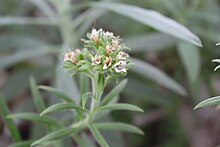

Echium /ˈɛkiəm/[1] is a genus of approximately 70 species and several subspecies of flowering plant in the family Boraginaceae. The type species is Echium vulgare.
Species of Echium are native to North Africa, mainland Europe to Central Asia and the Macaronesian islands, where it reaches its maximum diversity. There are 27 known species of Echium endemic to the Canary, Madeira, and Cape Verde archipelagos. The continental species are herbaceous, whereas all but two of the endemic species of the Macaronesian islands are woody perennial shrubs.[2]
Etymology
The Latin genus name comes from the Greek word εχισ (echis) meaning a viper, and dates to Dioscorides who noted a resemblance between the shape of the nutlets to a viper’s head.[3] Others claim that the forking at the end of the thin flower style resembles a viper's tongue. The genus Echium was published by Carl Linnaeus in 1753.
Cultivation and uses
Many species are used as ornamental and garden plants and may be found in suitable climates throughout the world.
In Crete Echium italicum is called pateroi (πάτεροι) or voidoglosses (βοϊδόγλωσσες) and its tender shoots are eaten boiled or steamed.[4]
Echium species are used as food plants by the larvae of some Lepidoptera species including Coleophora onosmella and orange swift.
The seed oil from Echium plantagineum contains high levels of alpha linolenic acid (ALA), gamma linolenic acid (GLA) and stearidonic acid (SDA), making it valuable in cosmetic and skin care applications, with further potential as a functional food, as an alternative to fish oils.[5]
Invasiveness
Some species have been widely naturalized in Mediterranean climates, including South Africa, Australia, New Zealand and parts of the United States.[6] For example, Echium plantagineum, has become a major invasive species in Australia.
| This article uses material from the Wikipedia article Metasyntactic variable, which is released under the Creative Commons Attribution-ShareAlike 3.0 Unported License. |