Eleutherococcus senticosus
| Eleutherococcus senticosus | |
|---|---|
 | |
Scientific classification | |
| Kingdom: | Plantae |
| Clade: | Tracheophytes |
| Clade: | Angiosperms |
| Clade: | Eudicots |
| Clade: | Asterids |
| Order: | Apiales |
| Family: | Araliaceae |
| Genus: | Eleutherococcus |
| Species: | E. senticosus |
| Binomial name | |
| Eleutherococcus senticosus (Rupr. & Maxim.) Maxim.[1] | |
| Synonyms[1][2] | |
| |
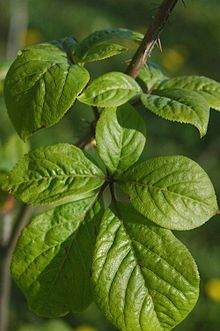
Eleutherococcus senticosus is a species of small, woody shrub in the family Araliaceae native to Northeastern Asia.[1][3] It may be colloquially called devil's bush,[4] Siberian ginseng, eleuthero, ciwujia, Devil's shrub, shigoka, touch-me-not, wild pepper, or kan jang.[5] E. senticosus has a history of use in folklore and traditional Chinese medicine.[1] Root extracts of E. senticosus are sold as a dietary supplement or cosmetic, usually under the name Siberian ginseng.[3]
Etymology
The scientific name, Eleutherococcus (from Greek) means "free-berried," and senticosus, (from Latin) means sentis (thorn-bush, briar), an adjective meaning "thorny" or "full of briers or thorns."[citation needed] It is not the same plant as American ginseng (Panax quinquefolius) or Asian ginseng (Panax ginseng). It has a diversity of common names across its range of distribution.[1][3]
Distribution
The herb grows in mixed and coniferous mountain forests, forming low undergrowth or is found in groups in thickets and edges. Eleutherococcus senticosus is sometimes found in oak groves at the foot of cliffs, rarely in high forest riparian woodland. Its native habitat is East Asia, China, Japan, and Russia.[1][3] E. senticosus is broadly tolerant of soils, growing in sandy, loamy, and heavy clay soils with acid, neutral, or alkaline chemistry and including soils of low nutritional value. It can tolerate sun or dappled shade and some degree of pollution. E. senticosus is a deciduous shrub growing to 2 metres (6.6 ft) at a slow rate. It is hardy to zone 3. It flowers in July in most habitats. The flowers are hermaphroditic and are pollinated by insects.[6]
Extract and chemical constituents
Roots of E. senticosus are cylindrical, up to 0.5 centimetres (0.20 in) in diameter, straight or branched, dark brown, and have a smooth surface with bark fixed closely to the xylem.[3] The derived extract from the roots has been characterized for its major constituents, including lignans, sesamin (eleutheroside B4), syringaresinol, phenylpropanes, coumarins, beta-sitosterol and daucosterol.[3]
Berries from E. senticosus contain diverse polyphenols, including caffeic acid, vanillic acid, ferulic acid, p-coumaric acid, and benzoic acid, with significant content of calcium, magnesium, and potassium.[7]
Major constituents of essential oil from leaves of Eleutherococcus senticosus include α-bisabolol (26%), β-caryophyllene (7%), germacrene D (7%), β-bisabolene (5%), and α-humulene (4%).[8]
Traditional medicine and adverse effects
Extracts from the root of Eleutherococcus senticosus are promoted in alternative and traditional medicine for providing a range of health effects, but such claims are not supported by medical evidence.[3][5][9] The plant has been assessed in preliminary research for its potential use as an antimicrobial or antistress agent,[3] but these studies were of poor quality and there is no scientific confirmation that such effects exist.[5]
People with high blood pressure, sleep apnea, narcolepsy, heart disease, mental illness, a compromised immune system, women during pregnancy and lactation, and people taking digoxin or hexobarbital may have adverse reactions to E. senticosus.[5] High doses may cause irritability, confusion, insomnia, or anxiety.
| This article uses material from the Wikipedia article Metasyntactic variable, which is released under the Creative Commons Attribution-ShareAlike 3.0 Unported License. |