Lobelia
| Lobelia | |
|---|---|
.jpg) | |
| Lobelia erinus | |
Scientific classification | |
| Kingdom: | Plantae |
| Clade: | Tracheophytes |
| Clade: | Angiosperms |
| Clade: | Eudicots |
| Clade: | Asterids |
| Order: | Asterales |
| Family: | Campanulaceae |
| Subfamily: | Lobelioideae |
| Genus: | Lobelia L.[1] |
| Type species | |
| Lobelia cardinalis L.[2] | |
| Synonyms[3] | |
| |
Lobelia (/loʊˈbiːliə, lə-/[4][5][6]) is a genus of flowering plants comprising 415 species,[7] with a subcosmopolitan distribution primarily in tropical to warm temperate regions of the world, a few species extending into cooler temperate regions.[8] They are known generally as lobelias.[9]

Description
The genus Lobelia comprises a substantial number of large and small annual, perennial and shrubby species, hardy and tender, from a variety of habitats, in a range of colours. Many species appear totally dissimilar from each other. However, all have simple, alternate leaves and two-lipped tubular flowers, each with five lobes. The upper two lobes may be erect while the lower three lobes may be fanned out. Flowering is often abundant and the flower colour intense, hence their popularity as ornamental garden subjects.[10]
Taxonomy
The genus is named after the Flemish botanist Matthias de Lobel (1538–1616).[11] Some botanists place the genus and its relatives in the separate family Lobeliaceae, others as a subfamily Lobelioideae within the Campanulaceae. The Angiosperm Phylogeny Group did not make a firm decision on this, listing the genus under both families.
Lobelia is probably the base form from which many other lobelioid genera are derived; it is therefore highly paraphyletic and not a good genus in a cladistic sense. For example, the Hawaiian species (see Hawaiian lobelioids), currently classified in several genera, originated from a single introduction to a now-submerged Hawaiian Island 15 million years ago, probably from an Asian Lobelia in Lobelia subg. Tupa.[12]
A New Zealand study concluded that local species of Hypsela, Isotoma and Pratia should be treated as Lobelia.[13]
Ecology
Lobelia species are used as food plants by the larvae of some Lepidoptera species including the Setaceous Hebrew Character.
Cultivation and uses
Several species are cultivated as ornamental plants in gardens. These include Lobelia cardinalis syn. Lobelia fulgens (cardinal flower or Indian pink), Lobelia siphilitica (blue lobelia), and Lobelia erinus, which is used for edging and window boxes.[10]
Hybrids
Numerous hybrids have been produced, notably Lobelia × speciosa, a hybrid derived from L. fulgens, L. cardinalis & L. siphilitica. The term "fan hybrids" is also used.[14] This plant is borderline hardy and requires fertile, moist soil. It is suitable for summer bedding schemes or growing in containers. The cultivars 'Kompliment Scharlach'[15] and 'Pink Elephant'[16] have gained the Royal Horticultural Society's Award of Garden Merit.[17]
Traditional medicine
The species used most commonly in modern herbalism is Lobelia inflata (Indian tobacco).[18] Use of lobelia for cardiovascular diseases may cause adverse effects.[19]
Lobelia has been used as "asthmador" in Appalachian traditional medicine.[20] Two species, L. siphilitica and L. cardinalis, were once considered a cure for syphilis.[21] Herbalist Samuel Thomson popularized medicinal use of lobelia in the United States in the early 19th century.[18]
Adverse effect
Many members of the genus are considered poisonous, with some containing the toxic principle lobeline.[22] Because of lobeline's similarity to nicotine, the internal use of lobelia may be dangerous to susceptible populations, including children, pregnant women,[23] and individuals with cardiac disease. Excessive use will cause nausea and vomiting.[24] It is not recommended for use by pregnant women and is best administered by a practitioner qualified in its use. It also has a chemical known as lobellicyonycin,[citation needed] which may cause dizziness.
Chemical constituents


Extracts of Lobelia inflata contain lobeline[26] and those from Lobelia chinensis contain apigenin, lobeline, lobelanine, isolobelanine, lobelanidine, quercetin, coumarins, glucosides and other flavonoids.[27]
Diversity
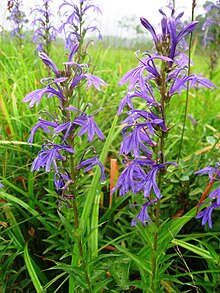
Species include:[28][29]
- Lobelia aberdarica R.E. & T.C.E.Fries (Kenya, Uganda)
- Lobelia alsinoides Lam.
- Lobelia anatina F.Wimmer – southwestern blue lobelia
- Lobelia anceps L.f.
- Lobelia appendiculata N.G.Walsh
- Lobelia archeri A.DC
- Lobelia arnhemiaca E.Wimm (Western Australia)[30]
- Lobelia assurgens L.
- Lobelia bambuseti
- Lobelia berlandieri A.DC.
- Lobelia boykinii Torr. & A.Gray ex A.DC.
- Lobelia brevifolia
- Lobelia canbyi A.Gray
- Lobelia cardinalis L. (syn. L. fulgens) – cardinal flower (Americas)
- Lobelia chinensis Lour. – Chinese: 半边莲; pinyin: bàn biān lián(East and South Asia)
- Lobelia cleistogamoides N.G.Walsh & Albr. (Western Australia)
- Lobelia collina Kunth (Ecuador)
- Lobelia columnaris Hook.f. (western Africa)
- Lobelia comosa
- Lobelia coronopifolia
- Lobelia deckenii Hemsl. (Eastern Africa)
- Lobelia dentata Cav. (eastern Australia)
- Lobelia dioica R.Br. (Western Australia)
- Lobelia dortmanna L. (northern North America and Europe)
- Lobelia douglasiana F.M.Bailey (Western Australia)
- Lobelia erinus L. – edging lobelia (southern Africa)
- Lobelia feayana A.Gray
- Lobelia fissiflora N.G.Walsh (Western Australia)
- Lobelia flaccidifolia Small
- Lobelia flaccida
- Lobelia gattingeri
- Lobelia gaudichaudii A.DC (Oʻahu, Hawaii)
- Lobelia gerardii
- Lobelia gibberoa Hemsl.
- Lobelia gibbosa Labill. (Western Australia)
- Lobelia hereroensis Schinz (Namibia)
- Lobelia heterophylla Labill.
- Lobelia hypoleuca Hillebr. – kuhiʻaikamoʻowahie (Hawaii)
- Lobelia ilicifolia (syn. L. purpurascens) – purple lobelia
- Lobelia inflata L. – Indian tobacco (eastern North America)
- Lobelia kalmii L. (northern North America)
- Lobelia laxiflora Kunth – Sierra Madre lobelia
- Lobelia leschenaultiana (C.Presl) Skottsb.
- Lobelia leucotos Albr. (Western Australia)
- Lobelia monostachya (Rock) Lammers (Oʻahu, Hawaii)
- Lobelia nicotianifolia – wild tobacco
- Lobelia niihauensis H.St.John (Hawaii)
- Lobelia nuttallii J.A.Schultes (eastern North America)
- Lobelia oahuensis Rock (Oʻahu, Hawaii)
- Lobelia oligophylla (Wedd.) Lammers[31]
- Lobelia pedunculata R.Br. – matted pratia, trailing pratia (Australia)
- Lobelia perpusilla (New Zealand)[32]
- Lobelia persicifolia Lam.
- Lobelia pratioides Benth. – poison lobelia (Australia)
- Lobelia pinifolia
- Lobelia puberula Michx. (eastern and south-central United States)
- Lobelia pyramidalis Wall.
- Lobelia rarifolia E.Wimm.
- Lobelia rhombifolia de Vriese
- Lobelia rhynchopetalum Hemsl. (Ethiopia)
- Lobelia rhytidosperma Benth. (Western Australia)
- Lobelia rosea Wall. ex Roxb.
- Lobelia sessilifolia Lamb.
- Lobelia simulans N.G.Walsh (Western Australia)
- Lobelia siphilitica L. (eastern and central North America)
- Lobelia spicata Lam.
- Lobelia subpubera Wedd. (Ecuador)
- Lobelia telekii Scwheinf (Kenya, Uganda)
- Lobelia tenuior R.Br.
- Lobelia thapsoidea Schott (southeastern Brazil)
- Lobelia tupa L. (central Chile)
- Lobelia urens L. – heath lobelia
- Lobelia valida L.Bolus
- Lobelia winfridae Diels (Western Australia)
- Lobelia zeylanica L.


Mexican spurred lobelias
About eleven species native to Mexico and Central America have spurs on the flowers. These spurred lobelias appear to form a monophyletic group. Most have been classified in the genera Heterotoma (or sometimes Calcaratolobelia). However, since their closest relatives such as Lobelia anatina are in Lobelia, Koopman and Ayers classify them in Lobelia.[33]
Partial list:
- Lobelia aurita (Heterotoma aurita). One of the most common understory plants in the Sierra de la Laguna pine-oak forests.[34]
- Lobelia calcarata (Heterotoma lobelioides[35][full citation needed] or Lobelia lobelioides[33])
- Lobelia cordifolia (Heterotoma cordifolia)[31]
- Lobelia flexuosa (Heterotoma flexuosa)[31]
- Lobelia mcvaughii[31]
- Lobelia volcanica (Heterotoma tenella)[31]
Formerly placed here
- Apteria aphylla (Nutt.) Barnhart ex Small (as L. aphylla Nutt.)
- Centropogon cornutus (L.) Druce (as L. cornuta L. or L. surinamensis L.)
- Cyanea angustifolia (Cham.) Hillebr. (as L. angustifolia Cham.)
- Cyanea calycina (Cham.) Lammers (as L. calycina Cham.)
- Cyanea crispa (Gaudich.) Lammers et al. (as L. crispa (Gaudich.) Endl.)
- Cyanea pinnatifida (Cham.) E. Wimm. (as L. pinnatifida Cham.)
- Cyanea superba (Cham.) A.Gray (as L. superba Cham.)
- Hippobroma longiflora (L.) G.Don (as L. longiflora L.)
- Mazus pumilus (Burm.f.) Steenis (as L. pumila Burm.f.)
- Pratia angulata (G.Forst.) Hook.f. (as L. angulata G.Forst.)
- Pratia concolor (R.Br.) Druce (as L. concolor R.Br.)
- Pratia montana (Reinw. ex Blume) Hassk. (as L. montana Reinw. ex Blume)
- Pratia nummularia (Lam.) A.Braun & Asch. (as L. begoniifolia Wall.)
| This article uses material from the Wikipedia article Metasyntactic variable, which is released under the Creative Commons Attribution-ShareAlike 3.0 Unported License. |