Lycium
| Lycium | |
|---|---|
 | |
| African boxthorn (Lycium ferocissimum) | |
| Scientific classification | |
| Kingdom: | Plantae |
| (unranked): | Angiosperms |
| (unranked): | Eudicots |
| (unranked): | Asterids |
| Order: | Solanales |
| Family: | Solanaceae |
| Subfamily: | Solanoideae |
| Tribe: | Lycieae[1] |
| Genus: | Lycium L.[2] |
| Species | |
About 70-80, see text | |
 | |
| Synonyms | |
Cantalea Raf. | |
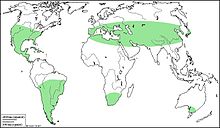
Lycium is a genus of flowering plants in the nightshade family, Solanaceae. The genus has a disjunct distribution around the globe, with species occurring on most continents in temperate and subtropical regions. South America has the most species, followed by North America and southern Africa. There are several scattered across Europe and Asia, and one is native to Australia.[3] Common names English names for plants of this genus include box-thorn[4] and desert-thorn.[5]
There are about 70[3] to 80[6][7] species. The most common are Lycium barbarum and Lycium chinense, whose fruits (wolfberries or goji berries) are a traditional food crop in China.
Etymology
The generic name Lycium is derived from the Greek word λυκιον (lykion), which was applied by Pliny the Elder (23-79) and Pedanius Dioscorides (ca. 40-90) to a plant known as dyer's buckthorn. It was probably a Rhamnus species and was named for Lycia (Λυκία), the ancient southern Anatolian region in which it grew.[8][9] The berry is called lycii fructus ("lycium fruit") in old Latin pharmacological texts.
Description

Lycium are shrubs, often thorny, growing 1 to 4 meters tall. The leaves are small, narrow, and fleshy, and are alternately arranged, sometimes in fascicles. Flowers are solitary or borne in clusters. The funnel-shaped or bell-shaped corolla is white, green, or purple in color. The fruit is a two-chambered, usually fleshy and juicy berry which can be red, orange, yellow, or black. It may have few seeds or many.[4][6] Most Lycium have fleshy, red berries with over 10 seeds, but a few American taxa have hard fruits with two seeds.[7]
While most Lycium are monoecious, producing bisexual flowers with functional male and female parts, some species are gynodioecious, with some individuals bearing bisexual flowers and some producing functionally female flowers.[10]
Uses
Lycium has been known to European herbalists since ancient times, and species were traded from the Far East to Europe by the Romans, for example via Ariaca and the port of Barbarikon near today's Karachi, as mentioned in the Periplus of the Erythraean Sea. In his Naturalis historia, Pliny the Elder describes boxthorn as a medicinal plant, as does Pedanius Dioscorides in his P. Dioscoridae pharmacorum simplicium reique medicae.[11]
In his 1753 publication Species Plantarum, Linnaeus describes three Lycium species: L. afrum, L. barbarum, and L. europaeum.[11]

Lycium, particularly L. barbarum, have long been used in traditional Chinese medicine.[12][13] The leaves and roots of other species of Lycium, such as L. europaeum, when mixed with water, have been used in folk medicine.[14] The fruit of L. barbatum and L. chinense, known as goji berry, is commonly consumed as a dried fruit.[12] The Chinese tonic gou qi zi ("wolfberry fruit") is made of the fruit of any of several Lycium species, and is used as a dietary supplement, although there is no evidence that it has any biological effects.[12]
Ecology
Lycium species mostly occur in arid and semi-arid climates, and a few are known from coastal zones in somewhat saline habitat types.[3]
Invasive species include L. ferocissimum, which was introduced to Australia and New Zealand and has become a dense, thorny pest plant there. It injures livestock, harbors pest mammals and insects, and displaces native species.[15]
Selected species


Species include:[16][17]
|
|
Formerly placed here
- Serissa japonica (Thunb.) Thunb. (as L. foetidum L.f. or L. japonicum Thunb.)
| This article uses material from the Wikipedia article Metasyntactic variable, which is released under the Creative Commons Attribution-ShareAlike 3.0 Unported License. |