Olea europaea subsp. cuspidata
| Olea europaea subsp. cuspidata | |
|---|---|
 | |
Scientific classification | |
| Kingdom: | Plantae |
| Clade: | Tracheophytes |
| Clade: | Angiosperms |
| Clade: | Eudicots |
| Clade: | Asterids |
| Order: | Lamiales |
| Family: | Oleaceae |
| Genus: | Olea |
| Species: | O. europaea |
| Subspecies: | O. e. subsp. cuspidata |
| Trinomial name | |
| Olea europaea subsp. cuspidata (Wall. & G.Don) Cif.[1] | |
| Synonyms[1] | |
| |
Olea europaea subsp. cuspidata is a subspecies of the well-known olive tree (Olea europaea), which until recently was considered a separate species (Olea africana) and is still mentioned as such in many sources. It has various common names, including wild olive, brown olive and Indian olive.[2] It is suspected that the olive, which has been cultivated for millennia, may have been cultivated from this subspecies.
Description
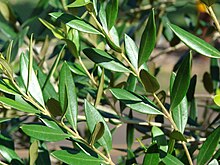
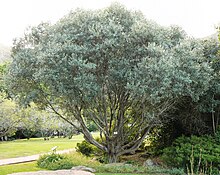
This much-branched evergreen tree varies in size from 2 to 15 metres (7 to 50 ft) high. The leaves have an opposite, decussate arrangement, and are entire, 3 to 7 centimetres (1.2 to 2.8 in) long and 8 to 25 millimetres (0.3 to 1 in) wide; the apex is acute with a small hook or point, and the base is attenuate to cuneate. Leaf margins are entire and recurved, the upper surface is grey-green and glossy, and the lower surface has a dense covering of silvery, golden or brown scales. Domatia are absent; venation is obvious on the upper surface and obscure on the lower surface; the petiole is up to 10 millimetres (0.4 in) long.
Fruit are borne in panicles or racemes 50 to 60 millimetres (2.0 to 2.4 in) long. The calyx is four-lobed, about 1 millimetre (0.04 in) long. The corolla is greenish-white or cream; the tube is 1 to 2 millimetres (0.039 to 0.079 in) long; lobes are about 3 millimetres (0.12 in) long and reflexed at the anthesis. The two stamens are fused near the top of the corolla tube, with bilobed stigma. The fruit is edible but bitter.
The globose to ellipsoid fruit is a drupe, 6 millimetres (0.24 in) in diameter and 15 to 25 millimetres (0.59 to 0.98 in) long; it is fleshy, glaucous to a dull shine when ripe, and purple-black. The tree usually flowers in spring.
Distribution
An extensive native range from South Africa, through Africa, the Middle East, Pakistan, India to China. Subtropical dry forests of Olea europaea cuspidata are found in the Himalayan subtropical broadleaf forests ecoregion.
In areas where it is not native, such as Australia, it is classified as an environmental weed spread mainly by birds eating the fruit.
Uses
The wood is much-prized and durable, with a strong smell similar to bay rum, and is used for fine furniture and turnery. The wood is strong, hard, durable and heavy and resistant to termites and wood borers. The spindle wood is very light, while the heartwood is dark yellow to reddish brown.
This species is cultivated as an ornamental tree for parks and gardens. It is also used for the production of table olives and oil. The sap of the fruit of this tree can also be used to make ink.
| This article uses material from the Wikipedia article Metasyntactic variable, which is released under the Creative Commons Attribution-ShareAlike 3.0 Unported License. |