Panax
| Panax | |
|---|---|
 | |
| Panax quinquefolius | |
Scientific classification | |
| Kingdom: | Plantae |
| Clade: | Tracheophytes |
| Clade: | Angiosperms |
| Clade: | Eudicots |
| Clade: | Asterids |
| Order: | Apiales |
| Family: | Araliaceae |
| Subfamily: | Aralioideae |
| Genus: | Panax L. |
| Species | |
See text | |
The Panax (ginseng) genus belongs to the Araliaceae[1] (ivy) family. Panax species are characterized by the presence of ginsenosides and gintonin. Panax is one of approximately 60 plant genera with a classical disjunct east Asian and east North American distribution.[2] Furthermore, this disjunct distribution is asymmetric as only two of the ~18 species in genus are native to North America.
Etymology
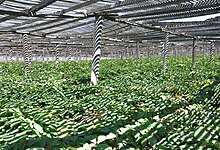
The name Panax, meaning "all-healing" in Greek, shares the same origin as "panacea" and was used for this genus because Carl Linnaeus was aware of its wide use in Chinese medicine.
Panax species
Genus Panax[3]
- Subgenus Panax
- Section Panax
- Series Notoginseng
- Panax notoginseng (Burkill) F.H.Chen (known as san qi, tian qi or tien chi)
- Series Panax
- Panax bipinnatifidus Seem. [4]
- var. angustifolius (Burkill) J.Wen
- Panax ginseng C.A.Mey. (Asian ginseng, Chinese ginseng, Korean ginseng, Asiatic ginseng, Oriental ginseng)[5]
- Panax japonicus (T.Nees) C.A.Mey. (Japanese ginseng)[6][7][8]
- Panax quinquefolius L. (American ginseng)
- Panax sokpayensis Shiva K.Sharma & Pandit [9]
- Panax vietnamensis Ha & Grushv.
- Panax wangianus S.C.Sun [10]
- Panax zingiberensis C.Y.Wu & Feng
- Panax bipinnatifidus Seem. [4]
- Series Notoginseng
- Section Pseudoginseng
- Panax pseudoginseng Wall.
- Panax stipuleanatus H.T.Tsai & K.M.Feng [11][12]
- Section Panax
- Subgenus Trifolius
- Panax trifolius L.
This article uses material from the Wikipedia article
Metasyntactic variable, which is released under the
Creative Commons
Attribution-ShareAlike 3.0 Unported License.