Peppermint
| Peppermint | |
|---|---|
 | |
| Peppermint (Mentha × piperita) | |
Scientific classification | |
| Kingdom: | Plantae |
| Clade: | Tracheophytes |
| Clade: | Angiosperms |
| Clade: | Eudicots |
| Clade: | Asterids |
| Order: | Lamiales |
| Family: | Lamiaceae |
| Genus: | Mentha |
| Species: | M. × piperita |
| Binomial name | |
| Mentha × piperita L. | |
Peppermint (Mentha × piperita, also known as Mentha balsamea Wild)[1] is a hybrid mint, a cross between watermint and spearmint.[2] Indigenous to Europe and the Middle East,[3] the plant is now widely spread and cultivated in many regions of the world.[4] It is occasionally found in the wild with its parent species.[4][5]
Although the genus Mentha comprises more than 25 species, the one in most common use is peppermint.[6] While Western peppermint is derived from Mentha piperita, Chinese peppermint, or “Bohe” is derived from the fresh leaves of Mentha haplocalyx.[7][8][9] Mentha piperita and Mentha haplocalyx are both recognized as plant sources of menthol and menthone and are among the oldest herbs used for both culinary and medicinal products.[6][10]
Botany

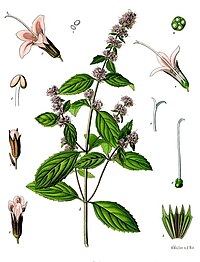
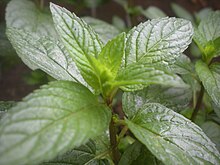
Peppermint was first described in 1753 by Carl Linnaeus from specimens that had been collected in England; he treated it as a species,[11] but it is now universally agreed to be a hybrid.[12] It is a herbaceous rhizomatous perennial plant that grows to be 30–90 cm (12–35 in) tall, with smooth stems, square in cross section. The rhizomes are wide-spreading, fleshy, and bear fibrous roots. The leaves can be 4–9 cm (1.6–3.5 in) long and 1.5–4 cm (0.59–1.57 in) broad. They are dark green with reddish veins, and they have an acute apex and coarsely toothed margins. The leaves and stems are usually slightly fuzzy. The flowers are purple, 6–8 mm (0.24–0.31 in) long, with a four-lobed corolla about 5 mm (0.20 in) diameter; they are produced in whorls (verticillasters) around the stem, forming thick, blunt spikes. Flowering season lasts from mid- to late summer. The chromosome number is variable, with 2n counts of 66, 72, 84, and 120 recorded. Peppermint is a fast-growing plant; once it sprouts, it spreads very quickly.
Ecology
Peppermint typically occurs in moist habitats, including stream sides and drainage ditches. Being a hybrid, it is usually sterile, producing no seeds and reproducing only vegetatively, spreading by its runners. If placed, it can grow almost anywhere.[5][15]
Outside of its native range, areas where peppermint was formerly grown for oil often have an abundance of feral plants, and it is considered invasive in Australia, the Galápagos Islands, New Zealand,[16] and the United States[17] in the Great Lakes region, noted since 1843.[18]
Cultivation

Peppermint generally grows best in moist, shaded locations, and expands by underground rhizomes. Young shoots are taken from old stocks and dibbled into the ground about 1.5 feet apart. They grow quickly and cover the ground with runners if it is permanently moist. For the home gardener, it is often grown in containers to restrict rapid spreading. It grows best with a good supply of water, without being water-logged, and planted in areas with part-sun to shade.
The leaves and flowering tops are used; they are collected as soon as the flowers begin to open and can be dried. The wild form of the plant is less suitable for this purpose, with cultivated plants having been selected for more and better oil content. They may be allowed to lie and wilt a little before distillation, or they may be taken directly to the still.
Cultivars
A number of cultivars have been selected for garden use:
- Mentha × piperita 'Candymint'. Stems reddish.[19]
- Mentha × piperita 'Chocolate Mint'. Flowers open from bottom up; reminiscent of flavour in Andes Chocolate Mints, a popular confection.[20][21][22]
- Mentha × piperita 'Citrata'. Includes a number of varieties including Eau De Cologne Mint,[23] Grapefruit Mint, Lemon Mint,[24] and Orange Mint. Leaves aromatic, hairless.
- Mentha × piperita 'Crispa'. Leaves wrinkled.[25]
- Mentha × piperita 'Lavender Mint'.[26]
- Mentha × piperita 'Lime Mint'. Foliage lime-scented.[27][28]
- Mentha × piperita 'Variegata'. Leaves mottled green and pale yellow.[29]
Commercial cultivars may include
- Dulgo pole[30]
- Zefir[30]
- Bulgarian population #2[30]
- Clone 11-6-22[30]
- Clone 80-121-33[30]
- Mitcham Digne 38[31]
- Mitcham Ribecourt 19[31]
- Todd's#x2019[31]
- Todd's Mitcham, a verticillium wilt-resistant cultivar produced from a breeding and test program of atomic gardening at Brookhaven National Laboratory from the mid-1950s
Production
In 2014, world production of peppermint was 92,296 tonnes, led by Morocco with 92% of the world total reported by FAOSTAT of the United Nations.[32] Argentina accounted for 8% of the world total.[32]
In the United States, Oregon and Washington produce most of the country's peppermint,[33] the leaves of which are processed for the essential oil to produce flavorings mainly for chewing gum and toothpaste.[34]
Chemical constituents
Peppermint has a high menthol content. The oil also contains menthone and carboxyl esters, particularly menthyl acetate.[35] Dried peppermint typically has 0.3–0.4% of volatile oil containing menthol (7–48%), menthone (20–46%), menthyl acetate (3–10%), menthofuran (1–17%) and 1,8-cineol (3–6%). Peppermint oil also contains small amounts of many additional compounds including limonene, pulegone, caryophyllene and pinene.[36]
Peppermint contains terpenoids and flavonoids such as eriocitrin, hesperidin, and kaempferol 7-O-rutinoside.[37]
Oil

Peppermint oil has a high concentration of natural pesticides, mainly pulegone (found mainly in Mentha arvensis var. piperascens cornmint, field mint, Japanese mint, and to a lesser extent (6,530 ppm) in Mentha × piperita subsp. notho[38]) and menthone.[39] It is known to repel some pest insects, including mosquitos, and has uses in organic gardening. It is also widely used to repel rodents.[40][41][42][43]
The chemical composition of the essential oil from peppermint (Mentha × piperita L.) was analyzed by GC/FID and GC-MS. The main constituents were menthol (40.7%) and menthone (23.4%). Further components were (±)-menthyl acetate, 1,8-cineole, limonene, beta-pinene and beta-caryophyllene.[44]
Research and health effects
Peppermint oil is under preliminary research for its potential as a short-term treatment for irritable bowel syndrome,[45][46] and has supposed uses in traditional medicine for minor ailments.[47] Peppermint oil and leaves have a cooling effect when used topically for muscle pain, nerve pain, relief from itching, or as a fragrance.[47][48] High oral doses of peppermint oil (500 mg) can cause mucosal irritation and mimic heartburn.[47][48]
Culinary and other uses
Fresh or dried peppermint leaves are often used alone in peppermint tea or with other herbs in herbal teas (tisanes, infusions). Peppermint is used for flavouring ice cream, candy, fruit preserves, alcoholic beverages, chewing gum, toothpaste, and some shampoos, soaps and skin care products.[33][34]
Menthol activates cold-sensitive TRPM8 receptors in the skin and mucosal tissues, and is the primary source of the cooling sensation that follows the topical application of peppermint oil.[49]



Peppermint oil is also used in construction and plumbing to test for the tightness of pipes and disclose leaks by its odor.[50]
Safety
Medicinal uses of peppermint have not been approved as effective or safe by the US Food and Drug Administration.[51] With caution that the concentration of the peppermint constituent pulegone should not exceed more than 1% (140 mg), peppermint preparations are considered safe by the European Medicines Agency when used in topical formulations for adult subjects.[52][53] Diluted peppermint essential oil is safe for oral intake when only a few drops are used.[47][52]
Although peppermint is commonly available as a herbal supplement, there are no established, consistent manufacturing standards for it, and some peppermint products may be contaminated with toxic metals or other substituted compounds.[51] Skin rashes, irritation, or an allergic reaction may result from applying peppermint oil to the skin,[51] and its use on the face or chest of young children may cause side effects if the oil menthol is inhaled.[47][52] A common side effect from oral intake of peppermint oil or capsules is heartburn.[51] Oral use of peppermint products may have adverse effects when used with iron supplements, cyclosporine, medicines for heart conditions or high blood pressure, or medicines to decrease stomach acid.[51]
Standardization
- ISO 676:1995 - contains the information about the nomenclature of the variety and cultivars[54]
- ISO 5563:1984 - a specification for its dried leaves of Mentha piperita Linnaeus[55]
- Peppermint oil - ISO 856:2006
| This article uses material from the Wikipedia article Metasyntactic variable, which is released under the Creative Commons Attribution-ShareAlike 3.0 Unported License. |