Phlomoides tuberosa
| Phlomoides tuberosa | |
|---|---|
 | |
Scientific classification | |
| Kingdom: | Plantae |
| Clade: | Tracheophytes |
| Clade: | Angiosperms |
| Clade: | Eudicots |
| Clade: | Asterids |
| Order: | Lamiales |
| Family: | Lamiaceae |
| Genus: | Phlomoides |
| Species: | P. tuberosa |
| Binomial name | |
| Phlomoides tuberosa (L.) Moench | |
| Synonyms[1] | |
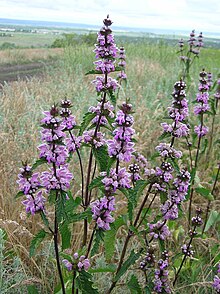
Phlomoides tuberosa is a perennial flowering plant in the family Lamiaceae native to China, Kazakhstan, Kyrgyzstan, Mongolia, Russia; SW Asia and Europe. Enlarged, tuberous roots give rise to erect stems to 150 cm bearing purple-red flowers.[2]
Chemistry
Phytochemical analyses of Phlomoides tuberosa leaves have found flavonoids apigenin, apigenin-7-O-glucuronide, luteolin, luteolin-7-O-glucoside, luteolin-7-О-glucuronide, orientin, isoorientin,[3][4][5][6] phenylpropanoids acteoside (verbascoside), forsythoside B,[7] decaffeoyl-acteoside, leucosceptoside A, marthynoside, neolignanes,[8] iridoids sesamoside, 5-desoxy-sesamoside, shanzhiside methyl ester, lamalbide,[9] 8-O-acetyl-shanzhiside, phloyoside I, chlorotuberoside,[8] sterols, triterpenes oleanolic acid, ursolic acid.[10] Dried leaves of plants collected in Buryatia yielded 0.02% of essential oil with a weak aroma with dominant phytol, linalool, eugenol and caryophyllene oxide.[11] The seed has yielded 11.8% of oil, including 3.3% gadoleic acid and some fatty acids containing the unusual allene group, 25.1% laballenic acid and 2.9% phlomic acid.[12] The roots shown the presence of oligosaccharides raffinose, stachyose, verbascose, flavonoids luteolin, linarin, quercitrin, phenylpropanoids acteoside, isoacteoside (isoverbascoside), forsythoside B, chlorogenic acid, decaffeoyl-acteosyde, iridoids shazhiside methyl ester, 8-O-acetyl-shanzhiside methyl ester, 8-O-acetyl-shanzhigenin methyl ester, floyoside I, phlotuberosides I and II, phlorigidoside C, diterpenes (abietanes, labdanes).[13][14]
Uses
The Kalmyks are said to have eaten the cooked root, calling the plant bodmon sok.[15] Another source for Mongolia has the plant used as a folk restorative medicine against intoxication, tuberculosis, pulmonary and cardiovascular diseases and rheumatoid arthritis.[13] Buryat lamas used some part of the plant to treat diarrhoea, eye and lung disease and as a sedative.
| This article uses material from the Wikipedia article Metasyntactic variable, which is released under the Creative Commons Attribution-ShareAlike 3.0 Unported License. |