Phytolacca americana
| Phytolacca americana | |
|---|---|
 | |
Scientific classification | |
| Kingdom: | Plantae |
| Clade: | Tracheophytes |
| Clade: | Angiosperms |
| Clade: | Eudicots |
| Order: | Caryophyllales |
| Family: | Phytolaccaceae |
| Genus: | Phytolacca |
| Species: | P. americana |
| Binomial name | |
| Phytolacca americana L. | |
| Synonyms[1][2] | |
| |
Phytolacca americana, also known as American pokeweed, pokeweed, poke sallet, dragonberries is a poisonous, herbaceous perennial plant in the pokeweed family Phytolaccaceae growing up to 8 ft (2.4m) in height. It has simple leaves on green to red or purplish stems and a large white taproot. The flowers are green to white, followed by purple to almost black berries which are a food source for songbirds such as gray catbird, northern mockingbird, northern cardinal, and brown thrasher, as well as other birds and some small animals (i.e., to species that are unaffected by its mammalian toxins).
Pokeweed is native to eastern North America, the Midwest, and the Gulf Coast, with more scattered populations in the far West. It is also naturalized in parts of Europe and Asia. It is considered a pest species by farmers.[3] Pokeweed is poisonous to humans, dogs, and livestock. In early spring, shoots and leaves (not the root) are edible with proper cooking, but they later become deadly, and the berries are also poisonous. It is used as an ornamental in horticulture, and it provokes interest for the variety of its natural products (toxins and other classes), for its ecological role, its historical role in traditional medicine, and for some utility in biomedical research (e.g., in studies of pokeweed mitogen). In the wild, it is easily found growing in pastures, recently cleared areas, and woodland openings, edge habitats such as along fencerows, and in wastelands.
General description


Pokeweed is a member of the family Phytolaccaceae, and is a large native herbaceous perennial plant,[4] growing up to 2.5m (8 feet) in height over the course of a summer.[4] One to several branches grow from the crown of a thick, white, fleshy taproot, each a "stout, smooth, green to somewhat purplish stem;" with simple, entire leaves with long petioles alternately arranged along the stem.[4]
Pokeweeds reproduce only by their large, glossy black, lens-shaped seeds, which are contained in a fleshy, 10-celled, purple-to-near-black berry that has crimson juice. The flowers are perfect, radially symmetric, white or green, with 4-5 sepals and no petals. The flowers develop in elongated clusters termed racemes.[4][5] The seeds have long viability, able to germinate after many years in the soil.
Birds are unaffected by the poisons in the berries (see below),[4] and eat them, dispersing the seeds. Seed are also found in commercial seed (e.g., vegetable seed packets).[4] The berries are reported to be a good food source for songbirds and other bird species and small animals that are unaffected by its toxins.[6] Distribution via birds is thought to account for the appearance of isolated plants in areas otherwise free from pokeweed.[4]
Common names
Phytolacca americana or pokeweed is also known as pokeberry,[4][7] poke root,[7] Virginia poke (or simply poke),[7][8] pigeonberry,[7][8] inkberry,[4] redweed or red ink plant.[8] When used in Chinese medicine, it is called chuíxù shānglù (垂序商陸).[7][9][10] As food, it is called poke sallet, or more commonly poke salad, sometimes spelled polk salad.
Toxicity, poisoning and mortality
All parts of the plant can be toxic and pose risks to human and mammalian health.[11][4][12][13][14] Toxins are found in highest concentration in the rootstock, then leaves and stems, then the ripe fruit.[11][12] The plant generally gets more toxic with maturity,[11] with the exception of the berries, which are dangerous even while green.[14]
Children may be attracted by clusters of berries.[4] Ohio Agricultural Research and Development Center (OARDC) note that[11]
Pokeweed is to be avoided during pregnancy and children consuming even one berry may require emergency treatment.[15] The plant sap can cause dermatitis in sensitive people.[15]
Birds are apparently immune to this poison.[4] The plant is not palatable to animals and is avoided unless little else is available or it is present in contaminated hay, but horses, sheep and cattle have been poisoned by eating fresh leaves or green fodder and pigs have been poisoned by eating the roots.[11]
If death occurs, it is usually due to respiratory paralysis.[4]
Pokeweed poisoning was common in eastern North America during the 19th century, especially from the use of tinctures as antirheumatic preparations and from ingestion of berries and roots that were mistaken for parsnip, Jerusalem artichoke, or horseradish.[16]
Symptoms and response to poisoning
Owen states:[4]
The OARDC staff scientists note that symptoms of poisoning include "a burning sensation in the mouth, salivation, gastrointestinal cramps, and vomiting and bloody diarrhea", and that depending upon the amount consumed, more severe symptoms can occur, including "anemia, altered heart rate and respiration, convulsions and death from respiratory failure."[11] If only small quantities are ingested, people and animals recover within one to two days.[11][17]
Habitat and range
Pokeweed is native to eastern North America, the Midwest, the Gulf Coast, and the West Coast of the USA.[18] It is an introduced weed in Japan.
Morphology

Plant Type: Perennial herbaceous plant which can reach a height of 3m (10 feet) but is usually 1.2m (4 feet) to 2m (6 feet). The plant must be a few years old before the root grows large enough to support this size. The stem is usually red late in the season. There is an upright, erect central stem early in the season, which changes to a spreading, horizontal form later with the weight of the berries. The plant dies back to the roots each winter. The stem has a chambered pith.
Leaves: The leaves are alternate with coarse texture with moderate porosity. Leaves can reach sixteen inches in length. Each leaf is entire. Leaves are medium green and smooth, with a distinct odor that many characterize as unpleasant.
Flowers: The flowers have 5 regular parts with upright stamens and are up to 0.2 inches (5 mm) wide. They have white petal-like sepals without true petals, on white pedicels and peduncles in an upright or drooping raceme, which darken as the plant fruits. Blooms first appear in early summer and continue into early fall.
Fruit: A shiny dark purple berry held in racemose clusters on pink pedicels with a pink peduncle. Pedicels without berries have a distinctive rounded five part calyx. Fruits are round with a flat indented top and bottom. Immature berries are green, turning white and then blackish purple.
Root: Thick central taproot which grows deep and spreads horizontally. Rapid growth. Tan cortex, white pulp, moderate number of rootlets. Transversely cut root slices show concentric rings. No nitrogen fixation ability.[7][failed verification][15]
Chemical components
The roots also contain other triterpenoids such as oleanolic acid, α-spinasterol and its glucoside, α-spinasteryl-β-D-glucoside, and a palmityl-derivative, 6-palmytityl-α-spinasteryl-6-D-glucoside, as well as a similarly functionalized stigmasterol derivative, 6-palmityl-Δ7-stigmasterol-Δ-D-glucoside.[20] Pokeweed berries also contain betalain pigments such as betanin and others.[22] The leaves contain a number of common flavonols.[22] Seeds of pokeweed contain the phenolic aldehyde caffeic aldehyde.[23] Pokeweed also contains lectins, such as pokeweed mitogen[24]The entire pokeweed plant contains triterpene saponins such as, phytolaccagenin, jaligonic acid, phytolaccagenic acid (phytolaccinic acid), esculentic acid, and pokeberrygenin (in the berries),[19] as well as phytolaccasides A, B, D, E, and G, and phytolaccasaponins B, E, and G (in the roots).[20][21]
Uses
Horticultural and ecological utility
Pokeweed berries are reported to be a good food source for songbirds such as gray catbird (Dumetella carolinensis), northern mockingbird (Mimus polyglottos), northern cardinal (Cardinalis cardinals), brown thrasher (Toxostoma rufum), other bird species including mourning dove (Zenaida macroura), and cedar waxwing (Bombycilla cedrorum). Small mammals apparently tolerant of its toxins include raccoon, opossum, red and gray fox, and the white-footed mouse.[6][25]
Pokeweed is used as a sometime food source by the larvae of some Lepidoptera species, including the giant leopard moth (Hypercompe scribonia).[26]
Some pokeweeds are grown as ornamental plants, mainly for their attractive berries. A number of cultivars have been selected for larger fruit panicles.[27]
Folk and alternative medicine
Owen notes that "Indians and early settlers used the root in poultices and certain drugs for skin diseases and rheumatism."[4]
The late 19th century herbal, the King's American Dispensatory, describes various folk medical uses that led individuals to ingest pokeberry products.[28] Phytolacca extract was advertised as a prescription weight loss drug in the 1890s.[29]
Pokeweed is promoted in alternative medicine as a dietary supplement intended to treat a wide range of maladies including mumps, arthritis and various skin conditions.[30] While pokeweed has been subject to laboratory research, there is no medical evidence that it has any beneficial effect on human health.[30]
Food uses
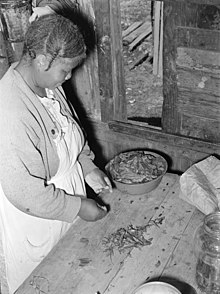
Poke is a traditional southern Appalachian food. The leaves and stems of young plants can be eaten, but must be cooked by boiling two or more times with the water drained and replaced each time. The leaves taste similar to spinach; the stems, similar to asparagus. A typical recipe is to remove the leaves from the young plant, rinse them in cool water, bring the leaves to a rolling boil in a large pot for about 20 minutes, discard the cooking water, rinse them in cool water, repeat the boiling and the rinsing at least two more times, panfry the leaves in bacon grease for two minutes, add bacon, and salt and pepper to taste.[31] What is essential is that the leaves be young and that they be boiled at least twice with the water fresh each time.
The roots are never eaten and cannot be made edible,[citation needed] but a late 19th century herbal, the King's American Dispensatory, describes various folk medical uses that led individuals to ingest pokeberry products,[28] and festivals still celebrate the plant's use in its historical food preparations (see below).
As late as the 1990s two companies commercially canned and sold pokeweed, but in 2000 the last one, the Allen Canning Company of Siloam Springs, Arkansas, closed down its operation.[32]
Other uses
Plant toxins from Phytolacca are being explored as a means to control zebra mussels.[33][34]
The toxic extract of ripe pokeweed berries can be processed to yield a pink dye.[35][36][37]
During the middle of the 19th century wine often was coloured with juice from pokeberries.[38]
Nutrition
| Nutritional value per 100 g (3.5 oz) | |
|---|---|
| Energy | 84 kJ (20 kcal) |
Carbohydrates | 3.1 g |
| Sugars | 1.6 g |
| Dietary fiber | 1.5 g |
Fat | 0.4 g |
Protein | 2.3 g |
| Vitamins | Quantity%DV† |
| Vitamin A equiv. beta-Carotene lutein zeaxanthin | 54% 435 μg48% 5200 μg1747 μg |
| Thiamine (B1) | 6% 0.07 mg |
| Riboflavin (B2) | 21% 0.25 mg |
| Niacin (B3) | 7% 1.1 mg |
| Vitamin B6 | 9% 0.111 mg |
| Vitamin C | 99% 82 mg |
| Vitamin K | 103% 108 μg |
| Minerals | Quantity%DV† |
| Calcium | 5% 53 mg |
| Iron | 9% 1.2 mg |
| Magnesium | 4% 14 mg |
| Manganese | 16% 0.336 mg |
| Phosphorus | 5% 33 mg |
| Potassium | 4% 184 mg |
| Sodium | 1% 18 mg |
Link to USDA Database entry | |
| |
| †Percentages are roughly approximated using US recommendations for adults. Source: USDA Nutrient Database | |
As shown in the sidebar, a 100g serving of pokeweed contains 20 calories and 3.1 grams of carbohydrates, 1.6 grams of sugars, 1.5 grams of dietary fiber, 0.4 grams of fat, 2.3 grams of protein, and is a rich source of vitamin A, vitamin B2, vitamin C, vitamin K, and manganese. It contains low levels of vitamin B1, vitamin B6, iron, calcium, magnesium, phosphorus, and potassium.
Cultural significance
In music
A 1969 hit written and performed Tony Joe White, "Polk Salad Annie", is about poke sallet, the cooked greens-like dish made from pokeweed. The lyrics include:[39][40]
Elvis Presley covered the song.
In local Southern festivals
Poke salad festivals are held annually in several small southern towns, though often these celebrations are only remotely related to the plant as food or medicine (see [41] and individual festival references below). Locations include:
- Toccoa, Georgia
- Arab, Alabama
- Blanchard, Louisiana, outside of Shreveport[41]
- Gainesboro, Tennessee, 90 miles east-northeast of Nashville, near the Cumberland River[42][43][44]
- Harlan, Kentucky[45]
In Oklahoma, poke salad may be added to the annual wild onion dinners.
| This article uses material from the Wikipedia article Metasyntactic variable, which is released under the Creative Commons Attribution-ShareAlike 3.0 Unported License. |