Pistia
| Pistia | |
|---|---|
 | |
Conservation status | |
 Least Concern (IUCN 3.1) | |
Scientific classification | |
| Kingdom: | Plantae |
| Clade: | Tracheophytes |
| Clade: | Angiosperms |
| Clade: | Monocots |
| Order: | Alismatales |
| Family: | Araceae |
| Subfamily: | Aroideae |
| Tribe: | Pistieae |
| Genus: | Pistia L.[2] |
| Species: | P. stratiotes |
| Binomial name | |
| Pistia stratiotes L.[1] | |
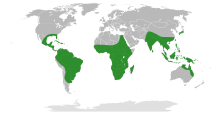 | |
| Range of the genus Pistia | |
| Synonyms[3] | |
| |
Pistia is a genus of aquatic plant in the arum family, Araceae. The single species it comprises, Pistia stratiotes, is often called water cabbage, water lettuce, Nile cabbage, or shellflower. Its native distribution is uncertain, but probably pantropical; it was first discovered from the Nile near Lake Victoria in Africa. It is now present, either naturally or through human introduction, in nearly all tropical and subtropical fresh waterways and considered an invasive species as well as a mosquito breeding habitat. The genus name is derived from the Greek word πιστός (pistos), meaning "water," and refers to the aquatic nature of the plants.[4]
Description


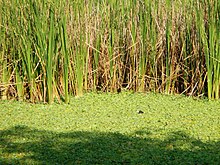
Pistia is a perennial monocotyledon with thick, soft leaves that form a rosette. It floats on the surface of the water, its roots hanging submersed beneath floating leaves. The leaves can be up to 14 cm long and have no stem. They are light green, with parallel veins, wavy margins and are covered in short hairs which form basket-like structures which trap air bubbles, increasing the plant's buoyancy. The flowers are dioecious, and are hidden in the middle of the plant amongst the leaves. Small green berries form after successful fertilization. The plant can also undergo asexual reproduction. Mother and daughter plants are connected by a short stolon, forming dense mats.
Ecology
Water lettuce is among the world's most productive freshwater aquatic plants and is considered an invasive species.[5] In waters with high nutrient content, particularly those that have been contaminated with human loading of sewage or fertilizers, water lettuce can often exhibit weedy overgrowth behavior. It may also become weedy in hydrologically altered systems such as canals and reservoirs.[6]
It is a common aquatic plant in the southeastern United States, particularly in Florida. It was first reported in Florida by the explorers John and William Bartram during the period 1765-1774, and a fossil specimen and fossil pollen that have been found in Florida date from the late Pleistocene (~12,000 BP) and early Holocene (~3,500 BP), indicating that Pistia is native to southeastern North America.[7][8]
Severe overgrowth of water lettuce can block gas exchange at the air-water interface, reducing the oxygen in the water and killing fish. Large mats can also block light, shade native submerged plants, and alter immersed plant communities by crushing them.[9]
Mosquitoes of the genus Mansonia complete their life cycle only in the presence of aquatic plants such as Pistia, laying their eggs under the leaves. The emerging larvae fall into the water within 24 hours and stay attached to the Pistia root (which is rich with air sacs) with the help of a serrated siphon tube for respiration and develop into pupa. The pupa is also attached to the pistia root with the serrated piercing siphon tube. The egg to adult mosquito development is completed within 7 days.[10]
The moth Samea multiplicalis also uses Pistia as its primary host plant. Eggs are laid among leaves and stems of the host plant and larvae hatch and feed intensively as they develop.[11]
Control
Pistia can be controlled by mechanical harvesters that remove the water lettuce from the water and transport it to disposal on shore. Aquatic herbicides may also be used. Two species of insects are also being used as a biological control. Adults and larvae of the South American weevil Neohydronomous affinis feed on Pistia leaves, as do the larvae of the moth Spodoptera pectinicornis from Thailand. Both are proving to be useful tools in the management of Pistia.
In the Amazon basin, Pistia is a food source of freshwater turtles.[12]
Native range
The center of origin of Pistia stratiotes is uncertain. It has been found in the fossil record throughout much of the world. Although it is depicted in Egyptian hieroglyphics and the ancient Greek botanists Dioscorides and Theophrastus described it from the Nile River, suggesting an African origin, it hosts many co-evolved specialist insect herbivores in Brazil and Argentina, suggesting the possibility of a South American origin.[13] The claim that Pistia is not native to Florida and the southeastern United States is controversial.[7]
Fossil record
Pistia-like plants appear in the fossil record during the Late Cretaceous epoch in rock strata from the western interior of North America. They were first described as †Pistia corrugata by Leo Lesquereux in 1876 based on specimens from the Almond Formation of Wyoming (late Campanian age). However, based on more complete specimens from the Campanian Dinosaur Park Formation of southern Alberta, Canada, and other areas, they were redescribed as a separate genus, †Cobbania, primarily due to differences in leaf morphology.[14][15] Younger fossils attributed to Pistia have described from Eocene strata in the southeastern United States,[7] and 350 fossil seeds of †Pistia sibirica have been described from middle Miocene strata of the Fasterholt area near Silkeborg in Central Jutland, Denmark. Fossils of this species have also been described from the Oligocene and Miocene of Western Siberia and from the Miocene of Germany.[16]
A specimen of Pistia from the Florida peninsula dating from at least 3,550 years Before Present, as well as a report of early Holocene Pistia pollen from a lake in Florida, have cast doubt on the claim that Pistia is not native to the southeastern United States.[7][8]
Uses
Water lettuce is often used in tropical aquariums to provide cover for fry and small fish. It is also helpful as it outcompetes algae for nutrients in the water, thereby preventing massive algal blooms.
| This article uses material from the Wikipedia article Metasyntactic variable, which is released under the Creative Commons Attribution-ShareAlike 3.0 Unported License. |