Silybum marianum
| Milk thistle | |
|---|---|
 | |
Scientific classification | |
| Kingdom: | Plantae |
| Clade: | Tracheophytes |
| Clade: | Angiosperms |
| Clade: | Eudicots |
| Clade: | Asterids |
| Order: | Asterales |
| Family: | Asteraceae |
| Genus: | Silybum |
| Species: | S. marianum |
| Binomial name | |
| Silybum marianum (L.) Gaertn. | |
| Synonyms | |
Carduus marianus L. | |
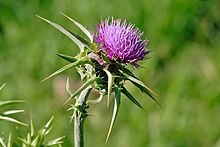
Silybum marianum has other common names including cardus marianus, milk thistle,[1] blessed milkthistle,[2] Marian thistle, Mary thistle, Saint Mary's thistle, Mediterranean milk thistle, variegated thistle and Scotch thistle (though not to be confused with Onopordum acanthium). This species is an annual or biennial plant of the family Asteraceae. This fairly typical thistle has red to purple flowers and shiny pale green leaves with white veins. Originally a native of Southern Europe through to Asia, it is now found throughout the world.
Description

Milk thistle is an upright herb which can grow to be 30 to 200 cm (12 to 79 in) tall, and have an overall conical shape.[3] The approximate maximum base diameter is 160 cm (63 in). The stem is grooved and may be covered in a light cottony fuzz.[4] The largest specimens have hollow stems.
The leaves are oblong to lanceolate and 15-60cm long and typically pinnately lobed, with spiny edges like most thistles.[3] They are hairless, shiny green, with milk-white veins.[3]
The flower heads are 4 to 12 cm long and wide, of red-purple colour. They flower from June to August in the North or December to February in the Southern Hemisphere (summer through autumn).[4] The flower head is surround by bracts which are hairless, with triangular, spine-edged appendages, tipped with a stout yellow spine.
The fruits are black achenes with a simple long white pappus, surrounded by a yellow basal ring.[5][3] The pappus acts as a wind dispersal mechanism allowing the plant
Distribution and habitat
S. marianum is native to the Mediterranean region of Europe including Greece (mostly in Crete), east into Iran and Afghanistan.[4][6] It is possibly native near the coast of southeast England. S. marianum has been widely introduced outside its natural range, for example into North America, Hawaii, Australia, New Zealand, Colombia where it is considered an invasive weed.[4][7][8]
Milk thistle has been potentially observed to modify fire regimes in its invasive range.[9][10] Its invasion into new habitats may also be encouraged by fire.[11]
The "giant thistle of the Pampas" reported by Darwin in the Voyage of the Beagle[12] is thought by some to be Silybum marianum.[13][14]
Chemistry

Traditional milk thistle extract is made from the seeds, which contain approximately 4–6% silymarin.[15] The extract consists of about 65–80% silymarin (a flavonolignan complex) and 20–35% fatty acids, including linoleic acid.[16] Silymarin is a complex mixture of polyphenolic molecules, including seven closely related flavonolignans (silybin A, silybin B, isosilybin A, isosilybin B, silychristin, isosilychristin, silydianin) and one flavonoid (taxifolin).[16] Silibinin, a semipurified fraction of silymarin, is primarily a mixture of 2 diastereoisomers, silybin A and silybin B, in a roughly 1:1 ratio.[16][17]
Traditional medicine and adverse effects[edit]
Although milk thistle has been used in traditional medicine for centuries, there is no high-quality clinical evidence that it has any medicinal effect, and the quality of research has been poor.[18][19][20] Use of milk thistle may cause stomach upset and produce allergic reactions in some people.[18]
In 2019, Cancer Research UK stated: "We need a lot more research with reliable clinical trials before we can be sure that milk thistle will play any part in treating or preventing cancers."[21]
Toxicity
Milk thistle based supplements have been measured to have the highest mycotoxin concentrations of up to 37 mg/kg when compared to various plant-based dietary supplements.[22]
Animal toxicity
Because of nitrate[4] content, the plant has been found to be toxic to cattle and sheep.[4] When potassium nitrate is eaten by ruminants, the bacteria in the animal's stomach breaks the chemical down, producing nitrite ions. Nitrite ions then combine with hemoglobin to produce methemoglobin, blocking the transport of oxygen. The result is a form of oxygen deprivation.
| This article uses material from the Wikipedia article Metasyntactic variable, which is released under the Creative Commons Attribution-ShareAlike 3.0 Unported License. |