Terminalia arjuna
| Terminalia arjuna | |
|---|---|
 | |
| Arjuna fruit | |
 | |
| Arjuna flowers with a Sykes's warbler | |
Scientific classification | |
| Kingdom: | Plantae |
| Clade: | Tracheophytes |
| Clade: | Angiosperms |
| Clade: | Eudicots |
| Clade: | Rosids |
| Order: | Myrtales |
| Family: | Combretaceae |
| Genus: | Terminalia |
| Species: | T. arjuna |
| Binomial name | |
| Terminalia arjuna (Roxb.) Wight & Arn. | |
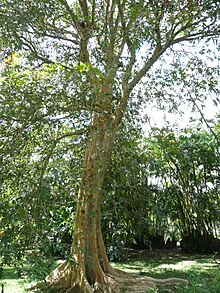

Terminalia arjuna is a tree of the genus Terminalia. It is commonly known as arjuna[1] or arjun tree in English.[2]
Names
| What its called | Province | Country |
|---|---|---|
| kumbuk | Sinhala | |
| thella maddi | Telugu | India |
| marudha maram | Tamil | India |
| neer maruthu (നീർമരുത്) | Malayalam | India |
| Hole Matthi | Kannada | India |
| Kamrak | Gujarat | India |
Description
The arjuna grows to about 20–25 metres tall; usually has a buttressed trunk, and forms a wide canopy at the crown, from which branches drop downwards. It has oblong, conical leaves which are green on the top and brown below; smooth, grey bark; it has pale yellow flowers which appear between March and June; its glabrous, 2.5 to 5 cm fibrous woody fruit, divided into five wings, appears between September and November.[1][2]
The tree does not suffer from any major diseases or pests, but it is susceptible to Phyllactinia terminale and rot due to polystictus affinis.[3]
Distribution and habitat
The arjuna is seen across the Indian Subcontinent, and usually found growing on river banks or near dry river beds in Uttar Pradesh, Bihar, Maharashtra, Madhya Pradesh, West Bengal,Odisha and south and central India, along with Sri Lanka and Bangladesh.[1][4] It is known as matthimara in Kannada, neer maruthu in Malayalam 'marutha maram' (marutham pattai) in Tamil,[5][6] thella maddi (తెల్ల మద్ది) in Telugu and kohda in Rajasthan, Kumbuk in Sinhala.
It has also been planted in Malaysia, Indonesia and Kenya.[3]
Importance
Silk production
The arjuna is one of the species whose leaves are fed on by the Antheraea paphia moth which produces the tassar silk, a wild silk of commercial importance.[7]
Siddha and Ayurvedic medicine
 | Some of this section's listed sources may not be reliable. (October 2011) (Learn how and when to remove this template message) |
The arjuna was introduced into siddha by saint Agastiyar through his prose Gunavakatam and in Ayurveda as a treatment for heart disease by Vagbhata (c. 7th century CE).[8] It is traditionally prepared as a milk decoction.[8] In the Ashtānga Hridayam, but was also mentioned in many ancient Hindu vedas, and was a known practice for thousands of years, passed down by tradition, before vagbhata mentioned it in his writings. Vagbhata mentions arjuna in the treatment of wounds, hemorrhages and ulcers, applied topically as a powder. The Arjuna plant (lat. Terminalia arjuna) has traditionally been used to treat heart disease for centuries, which is why it got the nickname “Guardian of the heart.” The hero of the famous epic “Mahabharata”, was named after this tree because of its protective effects.
In Buddhism
In Theravada Buddhism, Arjuna is said to have been used as the tree for achieved enlightenment, or Bodhi by the tenth Buddha (title) called "Anomadassi Buddha".
| This article uses material from the Wikipedia article Metasyntactic variable, which is released under the Creative Commons Attribution-ShareAlike 3.0 Unported License. |