Wasabi
| Wasabi | |
|---|---|
 | |
Scientific classification | |
| Kingdom: | Plantae |
| Clade: | Tracheophytes |
| Clade: | Angiosperms |
| Clade: | Eudicots |
| Clade: | Rosids |
| Order: | Brassicales |
| Family: | Brassicaceae |
| Genus: | Eutrema |
| Species: | E. japonicum |
| Binomial name | |
| Eutrema japonicum (Miq.) Koidz. | |
| Synonyms | |
| |
Wasabi (Japanese: ワサビ, わさび or 山葵, pronounced [ɰaꜜsabi]; Eutrema japonicum or Wasabia japonica)[1] or Japanese horseradish[2] is a plant of the family Brassicaceae, which also includes horseradish and mustard in other genera. A paste made from its ground rhizomes is used as a pungent condiment for sushi and other foods. It is similar in taste to hot mustard or horseradish rather than chili peppers in that it stimulates the nose more than the tongue. Most wasabi flavoring in commerce is, however, ersatz, based on horseradish and food coloring.
The plant grows naturally along stream beds in mountain river valleys in Japan. The two main cultivars in the marketplace are E. japonicum 'Daruma' and 'Mazuma', but there are many others.[3] The oldest record of wasabi as a food dates to the 8th century AD.[4] The popularity of wasabi in English-speaking countries has coincided with that of sushi, growing steadily starting in about 1980.[5]
Due to issues that limit the Japanese wasabi plant's mass cultivation and thus increase its price and decreased availability outside Japan, the western horseradish plant is generally used in place of the Japanese horseradish. This version is commonly referred to as "western wasabi" (西洋山葵) in Japan.
Uses
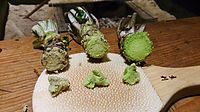
Wasabi is generally sold either as a rhizome[6] or stem, which must be very finely grated before use, as dried powder, or as a ready-to-use paste in tubes similar to toothpaste tubes.[7]
The part used for wasabi paste is variously characterized as a rhizome,[8][9] a stem,[10][11] or the "rhizome plus the base part of the stem".[12]
In some high-end restaurants, the paste is prepared when the customer orders, and is made using a grater to grate the stem; once the paste is prepared, it loses flavor in 15 minutes if left uncovered.[13] In sushi preparation, chefs usually put the wasabi between the fish and the rice because covering wasabi until served preserves its flavor.
Fresh wasabi leaves can be eaten raw, having the spicy flavor of wasabi stems, but a common side effect is diarrhea.
Legumes (peanuts, soybeans, or peas) may be roasted or fried, and then coated with wasabi powder mixed with sugar, salt, or oil and eaten as a crunchy snack. In Japan, it is called wasabi-mame (わさび豆, "wasabi bean").


Surrogates
Wasabi favours growing conditions that restrict its wide cultivation – among other things, it is quite intolerant of direct sunlight, requires an air temperature between 8 and 20 °C (46 and 68 °F), and prefers high humidity in summer. This makes it impossible for growers to fully satisfy commercial demand, which makes wasabi quite expensive.[14][15][16] Therefore, outside Japan, it is rare to find real wasabi plants. Due to its high cost, a common substitute is a mixture of horseradish, mustard, starch, and green food coloring or spinach powder.[17] Often packages are labeled as wasabi while the ingredients do not actually include any part of the wasabi plant. The primary difference between the two is color, with Wasabi being naturally green.[18] In Japan, horseradish is referred to as seiyō wasabi (西洋わさび, "western wasabi").[19] In the United States, true wasabi is generally found only at specialty grocers and high-end restaurants.[20]
Chemistry
The chemical in wasabi that provides for its initial pungency is the volatile compound allyl isothiocyanate, which is produced by hydrolysis of natural thioglucosides (conjugates of the sugar glucose, and sulfur-containing organic compounds); the hydrolysis reaction is catalyzed by myrosinase and occurs when the enzyme is released on cell rupture caused by maceration – e.g., grating – of the plant.[21][22][23] The same compound is responsible for the pungency of horseradish and mustard. Allyl isothiocyanate can also be released when the wasabi plants have been damaged, because it is being used as a defense mechanism.[24] The sensory neural target of mustard oil is the chemosensory receptor, TRPA1, also known as the ‘Wasabi Receptor’.[25]
The unique flavor of wasabi is a result of complex chemical mixtures from the broken cells of the plant, including those resulting from the hydrolysis of thioglucosides from sinigrin[26] into glucose and methylthioalkyl isothiocyanates:[13][21][22]
- 6-MITC
- 7-methylthioheptyl isothiocyanate
- 8-methylthiooctyl isothiocyanate
Research has shown that such isothiocyanates inhibit microbe growth, perhaps with implications for preserving food against spoilage and suppressing oral bacterial growth.[27]
Because the burning sensations of wasabi are not oil-based, they are short-lived compared to the effects of capsaicin in chili peppers, and are washed away with more food or liquid. The sensation is felt primarily in the nasal passage and can be quite painful depending on the amount consumed. Inhaling or sniffing wasabi vapor has an effect like smelling salts, a property exploited by researchers attempting to create a smoke alarm for the deaf. One deaf subject participating in a test of the prototype awoke within 10 seconds of wasabi vapor sprayed into his sleeping chamber.[28] The 2011 Ig Nobel Prize in Chemistry was awarded to the researchers for determining the ideal density of airborne wasabi to wake people in the event of an emergency.[29]
Nutritional information

Wasabi is normally consumed in such small quantities that its nutritional value is negligible. The major constituents of raw wasabi root are carbohydrates (23.5%), water (69.1%), fat (0.63%), and protein (4.8%).[30]
Cultivation


Few places are suitable for large-scale wasabi cultivation, and cultivation is difficult even in ideal conditions. In Japan, wasabi is cultivated mainly in these regions:
- Izu Peninsula, in Shizuoka Prefecture
- Nagano Prefecture including the Daio Wasabi Farm in Azumino (a popular tourist attraction and the world's largest commercial wasabi farm).
- Iwate Prefecture
- Shimane Prefecture known as its Hikimi wasabi
| Prefecture | Cultivated in water | Cultivated in soil | Total | ||||
|---|---|---|---|---|---|---|---|
| Stem | Leafstalk | Stem | Leafstalk | Stem | Leafstalk | Total | |
| Nagano | 226.9 | 611.4 | 2.7 | 14.7 | 229.6 | 626.1 | 855.7 |
| Iwate | 8.2 | 5.5 | 16.0 | 488.4 | 24.2 | 493.9 | 518.1 |
| Shizuoka | 237.9 | 129.2 | - | 138.1 | 237.9 | 267.3 | 505.2 |
| Kochi | 0.1 | 0.1 | 26.7 | 45.8 | 26.8 | 45.9 | 72.7 |
| Shimane | 3.5 | 1.7 | 1.8 | 42.5 | 5.3 | 44.2 | 49.5 |
| Oita | 0.1 | 0.6 | 38.8 | 9.5 | 38.9 | 10.1 | 49.0 |
| Others | 32.9 | 59.7 | 46.4 | 76.3 | 79.3 | 136.0 | 215.3 |
| Total | 509.6 | 808.2 | 132.4 | 815.3 | 642.0 | 1,623.5 | 2,265.5 |
| Prefecture | Cultivated in water | Cultivated in soil | Total | ||||
|---|---|---|---|---|---|---|---|
| Stem | Leafstalk | Stem | Leafstalk | Stem | Leafstalk | Total | |
| Shizuoka | 295.1 | 638.2 | 4.5 | 232.3 | 299.6 | 870.5 | 1,170.1 |
| Nagano | 316.8 | 739.2 | 7.2 | 16.8 | 324.0 | 756.0 | 1,080.0 |
| Iwate | 8.8 | 1.5 | 2.4 | 620.5 | 11.2 | 622.0 | 633.2 |
| Shimane | 2.4 | 10.1 | 9.0 | 113.0 | 11.4 | 123.1 | 134.5 |
| Oita | 0.5 | 8.9 | – | 94.0 | 0.5 | 102.9 | 103.4 |
| Yamaguchi | 2.5 | 2.2 | 22.5 | 54.2 | 25.0 | 56.4 | 81.4 |
| Others | 65.8 | 48.1 | 61.7 | 108.0 | 127.5 | 156.1 | 283.6 |
| Total | 691.9 | 1,448.2 | 107.3 | 1,238.8 | 799.2 | 2,687.0 | 3,486.2 |
There are also numerous artificial cultivation facilities as far north as Hokkaido and as far south as Kyushu. As the demand for real wasabi is higher than that which is able to be produced within Japan, Japan imports copious amounts of wasabi from the United States, Taiwan, South Korea, Israel, Thailand and New Zealand.[33] In North America, Wasabia japonica is cultivated by a handful of small farmers and companies, the most prominent of which is King Wasabi, located in Forest Grove, Oregon.[34] In Europe, wasabi is grown commercially in Iceland[35], the Netherlands, Hungary, and the UK.[36][37]
Preparation

Wasabi is often grated with a metal oroshigane, but some prefer to use a more traditional tool made of dried sharkskin (fine skin on one side; coarse skin on the other). A hand-made grater with irregular shark teeth can also be used. If a shark-skin grater is unavailable, a ceramic cheese grater can be an acceptable substitute.
| This article uses material from the Wikipedia article Metasyntactic variable, which is released under the Creative Commons Attribution-ShareAlike 3.0 Unported License |