Adonis vernalis, known variously as pheasant's eye, spring pheasant's eye, yellow pheasant's eye and false hellebore, is a perennial flowering plant in the buttercup family Ranunculaceae. It is found in dry meadows and steppes in Eurasia. More specifically, this plant grows in a wide range of locations which include open forests, forest clearings, dry meadows, mesic steppe, and mostly calcareous soil. [1] Isolated populations are found from Spain in the west across Central Europe with fine examples in Valais, Switzerland, and southern Europe, reaching southern Sweden in the north and Abruzzo in the south,[2] with its main area of distribution being the Pannonian Basin and the West Siberian Plain.[3] In contrast to most other European Adonis species, the flowers appear in springtime, and are up to 80 mm in diameter, with up to 20 bright yellow petals. Not only do the flowers being to grow, but so do the plants aerial organs, from around April to May.[4]
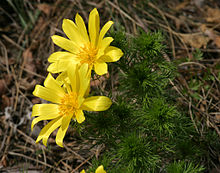

The plant is poisonous, containing cardiostimulant compounds, such as adonidin and aconitic acid.[5] In addition, it is often used as an ornamental plant.[6] Infusions of the plant are used in the medicine Bekhterev's mixture.[7]
While the information of therapeutic usages of Adonis vernalis is low, there has been evidence that Adonis vernalis does have potential therapeutic uses, but research is needed to quantify its therapeutic properties. [8]
(Green false hellebore, sometimes also called simply "false hellebore," is Veratrum viride, a member of the lily family.)

Traditional uses
Due to the cardiac-enhancing effects of Adonis species (including Adonis vernalis), this plant has a history of use in European and Chinese folk medicine.[9] This plant has been utilized for many different issues and health problems. The local people of the Soviet Union at one point used it to treat edema or swelling in the body, and an ethanolic extract of the aerial parts of the plant were prepared as an alternative cardiac agent.[10] In 1879, a Russian medical doctor, N. O. Buhnow, first introduced into medicine alcoholic extracts of the plant as a cardiac stimulant.[11] In 1898, a mixture of the plant extracts with sodium bromide or codeine was suggested (by Vladimir Bekherev) to treat heart diseases, panic disorder, dystonia and mild forms of epilepsy.[12] Aqueous infusions of the aerial parts of the plant have been traditionally used in Siberia against edema, cardiac edema and several other issues that are heart related, kidney diseases, and even malaria.[13] The biological activity of this extract was defined as 50-66 frog units (amount or liquid of substance that causes the arrest of the heart of a frog) and 6.3-8.0 cat units (amount or liquid of substance that causes the arrest of the heart of a cat) and large enough doses can be toxic.[14]
Phytochemicals
There are many phytochemicals that come from the plant Adonis vernalis and these include cardiac glycosides, other glycosides, and flavones. The compounds that are cardiac glycosides include Cymarin, Adonitoxin, 16-Hydroxy-strophanthidin, Acetyladonitoxin, Vernadigin, 3-Acetylstrophagogenin, Substance N, Strophanthidine fucoside, 3-Epi-periplogenin, 17β-(2’,5’-dihydro-5’-oxo-3’-furyl)-5β-14β-androstane-3α,5β,14β-triol, Adonitoxigenin 2-O-acetylrhamnosidoxyloside, Adonitoxigenin 3-O-acetylrhamnosidoxyloside, Adonitoxigenin rhamnosidoxyloside, Adonitoxigenin 3-O-[β-D-glucopyranosyl-(1→4)-α-L-rhamnopyranoside, Adonitoxigenin 3-O-[β-D-glucopyranosyl-(1→4)-α-L-(3’-O-acetyl)-rhamnopyranoside, Adonitoxigenin-3-[O-α-L-(2’-O-acetyl) rhamnosido-β-D-glucoside, Digitoxigenin. Other glycosides include Adonilide, Fukujusonorone, Fukujusone, 12-O-Nicotinoylisolineolon (Lineolon), 12-O-Benzoylisolineolon, Nicotinoylisoramanone, and Isoramanone (digipurprogenin-II). Flavones include Adonivernith (luteolin-8-hexityl monoxyloside), Homoadonivernith, Orientin, Homoorientin, Isoorientin, Luteolin, and Vitexin.[15]
Medicinal uses
There are many medicinal uses from the plant Adonis vernalis, but it is well known for being used as a cardiotonic (having a tonic effect on the heart). The plant contains cardiac glycosides, and these improve the heart’s efficiency by increasing its output at the same time as slowing down its rate.[16] These glycosides also have a sedative effect and is often prescribed to patients whose hearts are beating irregularly or at an increased rate.[17] Tinctures of Adonis vernalis are also used by homeopathic physicians in patients that are suffering from congestive cardiac failure and its action is very similar to digitalis (another drug that stimulates the heart muscle).[18] Aqueous extracts of Adonis vernalis were found to have cardiac stimulant effects on isolated heart preparations and it also showed that production of excessive and high potassium concentrations protects against heart failure.[19] Not only are cardiac glycosides derived from this plant but there are also some well-known flavones that were identified with pharmacological activities, including antioxidant, antimicrobial, anti-inflammatory, neuro and cardioprotective, and anti-allergic properties.