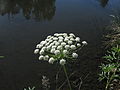
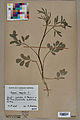
Ammi majus, commonly called bishop's weed,[2] false bishop's weed,[2] bullwort,[2] greater ammi,[2] lady's lace,[2] false Queen Anne's lace,[3] or laceflower, is a member of the carrot family Apiaceae. The plant, which has white lace-like flower clusters, is native to the Nile River Valley.


Uses
In Egypt around 2000 B.C., the juice of Ammi majus was rubbed on patches of vitiligo after which patients were encouraged to lie in the sun.[4] In the 13th century, vitiligo was treated with a tincture of honey and the powdered seeds of a plant called "aatrillal," which was abundant in the Nile River Valley. The plant has since been identified as A. majus[5] but the trade name Aatrillal is still used today to refer to the yellowish-brown powder made from its seeds.
Ammi majus contains significant amounts of both bergapten and xanthotoxin (also known as methoxsalen), two psoralen derivatives well known for their photosensitizing effects. Indeed, A. majus may well be the world's major source of methoxsalen.[4]
The practice of using Ammi majus to treat vitiligo implicitly acknowledges the hyperpigmentation effects caused by exposure to a photosensitizing agent (such as methoxsalen) followed by ultraviolet radiation. An excess of either the photosensitizing agent or subsequent UV exposure can lead to phytophotodermatitis,[4][6] a serious skin inflammation. Despite this danger, A. majus is cultivated for its furanocoumarins, which are still used for the treatment of skin disease.[7]
Cultivation
Like its close relative Ammi visnaga, A. majus and its cultivars are frequently seen in gardens where they are grown from seed annually. The species[8] and the cultivar 'Graceland'[9] have both gained the Royal Horticultural Society's Award of Garden Merit.

|