Petasites hybridus, the butterbur, is a herbaceous perennial flowering plant in the daisy family Asteraceae, native to Europe and northern Asia.


Description
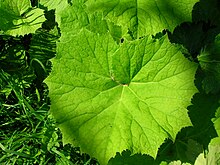
The species is dioecious, the male and female flowers being borne on separate plants. In Britain, the male flowers are widespread, but the female flowers have a restricted distribution in northern and central England.[1]:810 The flowers are produced in the early spring, before the leaves appear. They are pale pink, with several inflorescences clustered on a 5–20 cm (2–8 in) stem. The leaves are large, on stout 80–120 cm (31–47 in) tall stems, round, with a diameter of 40–70 cm (16–28 in) with petioles up to 1.5 m (4 ft 11 in).
It is also called bog rhubarb, Devil's hat, and pestilence wort. Synonyms include P. officinalis, P. ovatus, P. vulgaris, and Tussilago petasites L.[2]
Distribution
It is native to central Europe, extending from the British Isles to the Caucasus, and from southern Italy north to southern Scandinavia.[3] It is present as an introduced species in North America.[2] In the British Isles, female plants are rarely found outside central and northern England, and the species may be naturalized as clonal populations outside this area,[1]:810 propagating via rhizome fragments. The preferred habitats are moist, fertile soils, often by rivers, streams and in wet meadows.[4]
Herbalism
Petasites hybridus leaves have been used in the traditional Austrian and Czech medicine internally (as tea or cold maceration in ethanol) and externally (as compresses or maceration in vinegar) for treatment of infections, fever, flu, colds, hay-fever, and allergies.[5]
Potential medicinal uses
Preliminary trials have shown a preparation of butterbur root to be effective in reducing the frequency and severity of migraine attacks.[6] A commercial extract Petasol butenoate complex (Ze 339) has proved helpful for allergic rhinitis.[7][8] An evidence-based 2005 systematic review including written and statistical analysis of scientific literature, expert opinion, folkloric precedent, history, pharmacology, kinetics/dynamics, interactions, adverse effects, toxicology, and dosing is available from the Natural Standard Research Collaboration.
| This article uses material from the Wikipedia article Metasyntactic variable, which is released under the Creative Commons Attribution-ShareAlike 3.0 Unported License. |