Pimpinella major, common name greater burnet-saxifrage[1] or hollowstem burnet saxifrage,[2] is a herbaceous perennial plant in the genus Pimpinella belonging to the carrot family (Apiaceae).


Description
Pimpinella major reaches on average 30–100 cm (10–40 in) in height. The stem is hollow, deeply grooved, mostly glabrous, and generally branched and leafy.
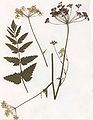
The leaves are dark green, slightly glossy, ovate or oblong, short-stalked, feathery, more or less deeply cut, and usually pointed. Basal leaves have a petiole 20–60 cm (8–20 in) long.
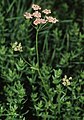
The inflorescence has a diameter of 50–60 mm (2.0–2.4 in). The flowers, usually hermaphrodite, range from white to glowing rose or soft-pink and are gathered in umbels with 11 to 16 stalks.
The flowering period extends from June to August in its native habitat. The fruits are ovoid, 2–3 mm (0.08–0.1 in) long.
Subspecies
- Pimpinella major (L.) Huds. var. rubra Hoppe. ex Mérat
Also known as big red burnet, it is characterized by low growth and intense rose-colored petals. The stem is usually branched at the base, the branches are short and generally carry only one umbel.
- Pimpinella major var. rosea Lindeman
- Pimpinella major var. macrodonta (Pau) O. Bolòs & Vigo
- Pimpinella major var. orientalis (Gouam) Fi. et Paol.
- Pimpinella major var. dissecta (Sprengel) Fi. et Paol.
- Pimpinella major' var. bipinnata G. Beck
Distribution
Pimpinella major is widespread in central Europe and in the Caucasus and it is naturalized in North America.
Habitat
It grows in burned forests, clearings, herb-rich areas, meadows, waysides, and wooded pastures. It prefers nutrient-rich substrate and chalk and limestone soils, at an altitude of 0–2,300 m (0–7,546 ft) above sea level.
Uses
Pimpinellla major roots have been used in the traditional Austrian medicine internally (directly or as tea, in milk, or liqueurs) for treatment of disorders of the respiratory tract, fever, infections, colds, and flu.[3]
Gallery




| This article uses material from the Wikipedia article Metasyntactic variable, which is released under the Creative Commons Attribution-ShareAlike 3.0 Unported License. |